
Legacy acts are quietly outwriting the algorithm this summer
Robert Smith on a Rolling Stones bridge, the Yummy Fur back after 28 years, Fiona Apple scoring a prestige miniseries, Hayley Williams covering Sinéad O'Connor, Queens of the Stone Age burying the setlist formula, and Victor Willis's death — six stories this week that all argue the same thing: the people who built the genres are still writing better songs than the systems that replaced them.
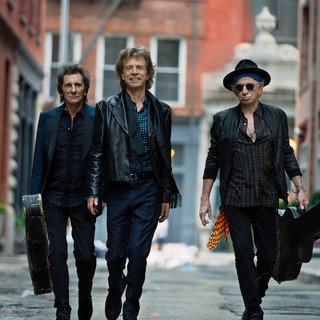
Photo via Spotify
“Divine Intervention” is a Rolling Stones song for about ninety seconds. Then the bridge opens up and it’s a Cure song wearing a Stones song’s clothes — a gothy, bent-note guitar line that could only belong to one working guitarist on Earth. That guitarist is Robert Smith, and his fingerprints on a track from a band pushing eighty are the clearest evidence yet of something this week’s music news keeps proving from six different directions: right now, the people who invented these sounds are writing more interesting music than the machinery built to replace them.
The Stones let someone else drive
“Divine Intervention” and its companion single “Jealous Lover” are the first tastes of Foreign Tongues, the Rolling Stones’ 25th studio album, due July 10 via Capitol and produced by Andrew Watt. The record is stacked with guests — Paul McCartney, Chad Smith, and posthumous drum tracks from Charlie Watts recorded before his 2021 death — but Smith is the one who changes the chemistry of the song rather than decorating it. “Jealous Lover” is a groovy, falsetto-led Stones cut with Steve Winwood sitting in; it’s fine, and it sounds like a band checking a box. “Divine Intervention” starts as a bluesy rocker and then hands the chorus to Smith’s bent, feedback-laced tone, and suddenly it sounds like a real decision instead of a legacy act going through its paces.
That’s the difference worth naming. A guest feature can be a marketing beat or it can be a genuine risk. Mick Jagger picking the frontman of The Cure — an act whose whole career runs counter to the Stones’ bar-band bluster — is the second kind. It’s also a reminder that “(I Can’t Get No) Satisfaction” still sits on our own guitar-riff canon for a reason: the Rolling Stones built half of rock’s vocabulary on exactly this kind of unlikely collision, decades before “featuring” became a chart-strategy checkbox.
The Yummy Fur didn’t need an algorithm to matter
Meanwhile, the Yummy Fur are releasing their first album in 28 years. The Glasgow trio broke up in 1999 after two members, Alex Kapranos and Paul Thomson, went on to found Franz Ferdinand — the band that spent the mid-2000s teaching post-punk revival to a generation of playlists. Everybody Talks About The Weather arrives September 25 on Upset The Rhythm, with the lead single “Unity Over Europe” — a heavy, snarling groove with piercing high-end guitar — out this week.
Post-punk revival has been a genre tag on every algorithmic “new indie” playlist for a decade now, and most of what lands there sounds like a mood board rather than a band. The Yummy Fur, by contrast, are the actual source code: the hyper-literate, abrasive art-punk that Franz Ferdinand smoothed into radio hits. It’s not a loose comparison, either — guitarist Dino Bardot went on to join Franz Ferdinand as well, meaning the entire lineage of that mid-2000s post-punk sound runs directly through this one Glasgow trio. A 28-year gap doesn’t make a reunion automatically good, but it does mean John McKeown, Paul Thomson, and Brian MacDougall are showing up with the real, specific version of a sound that streaming has spent years flattening into a genre tag.
Fiona Apple takes the prestige-TV job over the blockbuster
Fiona Apple wrote a new piece for the title sequence of Lucky, the Apple TV+ miniseries premiering July 15. It’s an original composition, co-produced with her longtime drummer Amy Aileen Wood — not a licensed back-catalog track dropped into a needle-drop slot, which is the easy, lucrative version of this job. Anya Taylor-Joy, who stars alongside Timothy Olyphant, said the show needed music that was “mostly female-centric” with “a rock edge,” and praised the “timbre and a rawness and a gravelliness” of Apple’s voice as “a perfect description of this series.”
There’s a quiet symmetry worth noting: Taylor-Joy also stars in the video for the Stones’ “Jealous Lover,” so the same actor is the face of both a legacy band’s guest-heavy comeback single and a legacy songwriter’s from-scratch score this month. Apple releases on nobody’s schedule but her own — a handful of records across three decades — and when she does surface, it’s to do the harder thing. Writing new music for a title sequence is a fraction of the exposure of a single, and it’s exactly the kind of work that doesn’t move a streaming needle. She did it anyway, because the job was interesting.
Hayley Williams picks the uncomfortable tribute
In Dublin on July 1, closing her first solo European tour at the National Stadium, Hayley Williams covered Sinéad O’Connor’s “Mandinka” — O’Connor’s own 1987 debut single. After the crowd broke into “Free Palestine” chants, Williams told the room: “This goes out to all the Irish artists who use their voice. You’re so inspiring.” It’s the second time she’s done this in the city — Paramore covered The Cranberries’ “Dreams” on the same stage in 2023.
A safer tribute plays “Nothing Compares 2 U” and lets the room cry quietly. Williams picked the debut single instead — the electric, confrontational O’Connor, not the ballad version audiences already know how to feel about. That’s a specific, considered choice about which part of a legacy to carry forward, and it’s the opposite of the algorithm’s instinct to serve people the version of a song they’ve already streamed the most.
Queens of the Stone Age throw out the setlist formula
Queens of the Stone Age opened their European run at Stockholm’s Strawberry Arena on June 29 by playing “Run, Pig, Run,” a dark, off-kilter cut from 2007’s Era Vulgaris that they hadn’t touched since 2008. They also dusted off “The Fun Machine Took A Shit And Died,” from the same album, for the first time since 2014 — while opening for System of a Down, in front of a crowd that mostly showed up for the headliner.
Every data-driven setlist tool built for arena tours points the same direction: open big, keep the hits coming, protect the average attention span. Josh Homme did the opposite on night one of a European tour, in front of a crowd that had mostly bought tickets to see System of a Down, betting eighteen years of audience memory against two songs nobody in that building was chanting for. That’s not nostalgia. It’s a band that still trusts its own catalog more than it trusts a formula — and trusts that a crowd there for someone else’s headline slot can still be won over by “Era Vulgaris” deep cuts instead of the singles they came in humming.
Victor Willis and the craft under the costume
Victor Willis, the founding lead singer of the Village People and co-writer of “Y.M.C.A.,” “Macho Man,” and “In the Navy,” died June 30 at 74 after a short, aggressive illness. Born in Texas in 1951, Willis grew up singing gospel in the church where his father preached, and that background is audible in the Village People’s records if you’re listening for it — the lead vocal on “Y.M.C.A.” isn’t a novelty-act performance, it’s a trained gospel voice carrying a disco song with real technical control.
It’s easy to remember the Village People as a costume gimmick and forget that gimmick sat on top of actual songwriting. Willis’s death is a reminder that some of the biggest “disposable” pop of the disco era was disposable in marketing only — the craft holding it up came from the same gospel tradition that built soul, and it’s outlasted plenty of music that took itself more seriously at the time.
The through-line
None of these six stories needed an algorithm to happen. A guitarist picked a song worth wrecking. A broken-up trio finished what they started instead of chasing what Franz Ferdinand built from their blueprint. A songwriter scored a title sequence for the craft of it. A singer chose the uncomfortable cover over the comfortable one. A band bet on memory over metrics. A gospel-trained voice turned a novelty act into a genuine songwriting legacy, and that legacy is what’s actually being mourned this week — not a costume.
Formula optimizes for what already worked. Every act above did something a recommendation engine would never suggest, and every one of them made the more interesting record, tribute, or set for it. That’s the case for legacy artists in 2026 — not that they’re owed nostalgia points, but that the people who built these genres by hand are still better at finding the risk worth taking than anything trained on what already streams well.