

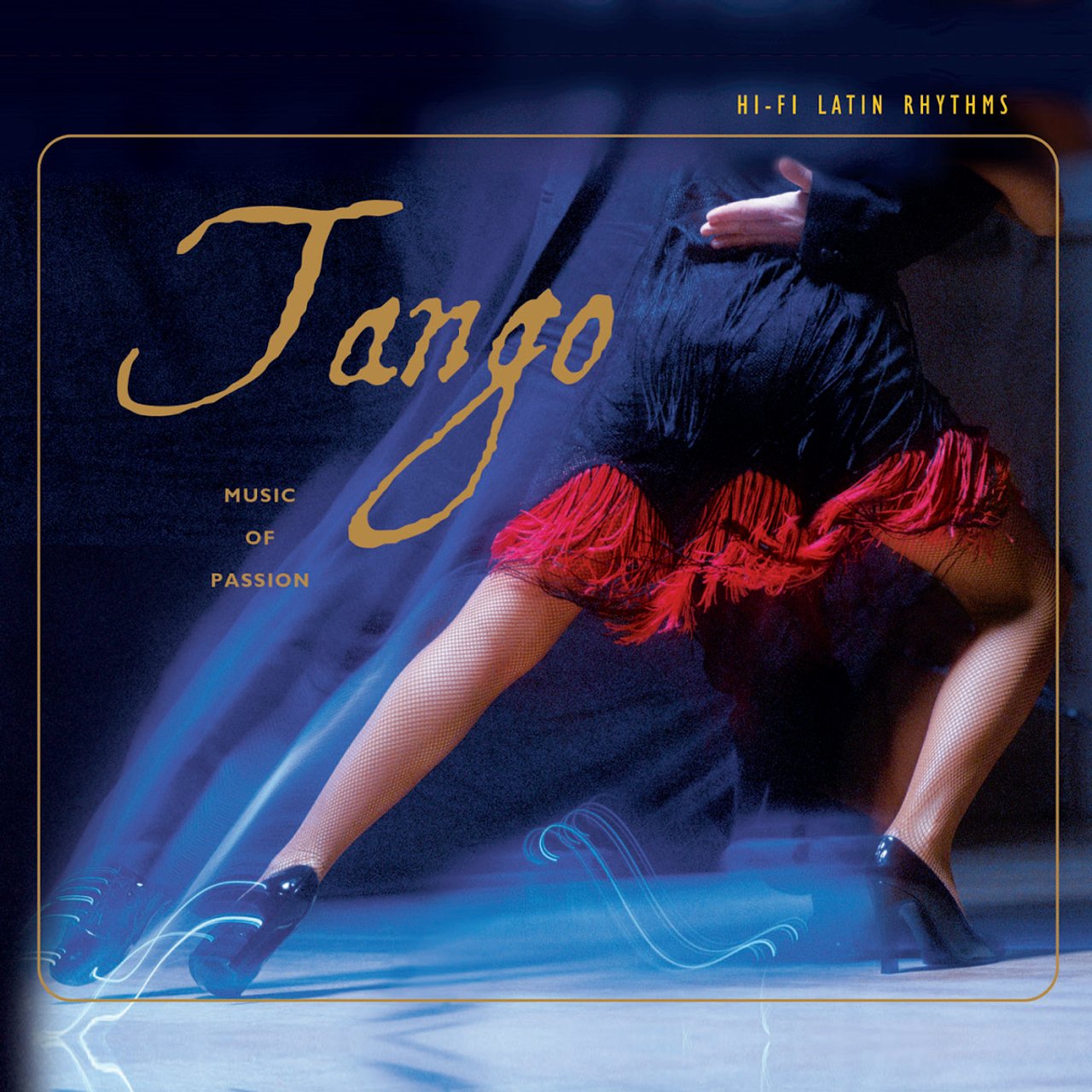
Hi-Fi Latin Rhythms: featuring a tango compilation from outside the box
Why we featured a 10-track Argentine tango compilation we didn't make: the lost language of late-1950s hi-fi LPs, the difference between listening-tango and dancing-tango, and what 'Music of Passion' actually does to a dinner party that the algorithm can't.
Cover via YouTube
Here is something true about ‘La Cumparsita,’ the song at the center of the Argentine tango canon: it is, by most reckonings, the most-recorded tango ever written, and it gets played at least once at every milonga in every city in the world that runs a Saturday-night session. I cannot tell you whether the version on this compilation is the one I would have chosen, because the tracklist isn’t surfacing in YouTube’s web playlist view — the page just returns “10 unavailable videos are hidden.” What I can tell you is that the compilation as a whole — 10 tracks, “Various Artists,” uploaded to YouTube Music in February 2025 with 7,879 views on it by the time I clicked through — is doing what a late-1950s hi-fi LP was supposed to do. It is holding a room without asking the room for anything.
This essay is about that compilation, why we featured it on the homepage, and what it means to pull an outside playlist into a site that is otherwise built entirely from our own crates. The short version is: the cover art earned the click, the music earned the slot, and the kind of music it is — listening-tango, not dancing-tango — is a kind we don’t have anywhere else on the site. So we made room.
What “Hi-Fi” used to mean on a record sleeve
The phrase “Hi-Fi Latin Rhythms” is a tell. Specifically, it’s the tell of a late-1950s American LP marketed to people who had just spent a meaningful percentage of their annual salary on a stereo console and needed something to play through it on Saturday night. The hi-fi era — call it 1955 through 1963, with a long tail through the mid-60s — produced a specific commercial category of record: the demonstration LP. These were compilations of music chosen not for narrative or for completeness but for fidelity. A bandoneón is a hard instrument to record well. A violin section in a tango orchestra is harder. The records that pulled this off, in mono and then in early stereo, ended up on every hi-fi shop’s demo turntable when somebody walked in to buy an amplifier.
Latin rhythms had a particular place in that catalog. Mambo, cha-cha, rumba, samba, and tango all moved a lot of well-recorded LP units to a postwar American middle class that wanted to sound cosmopolitan without learning Spanish. The records were beautifully engineered, mostly anonymous on the back cover (“Various Artists,” “Original Recordings,” “Performed by Orchestras of”), and built to play through dinner without anyone asking who was on track six. They were, in short, the original premium background music — but with one distinction from what came later: the engineers actually cared. The dynamic range was real. The room sound was real. A bandoneón breathing through a tube-driven monitor in 1959 was a thing you could feel in the chest from across the room.
This compilation, posted to YouTube Music in February 2025 and quietly accumulating 7,879 views by the time we got to it, is descended from that lineage. I do not know who pressed it, or whether the recordings are genuine archival material or modern session reconstructions made to sound like archival material. The “Various Artists • Album” tag on the YouTube Music page is doing a lot of work. What I can tell you is that the cover image — deep navy, almost black; a vintage type treatment; a single ornamental motif — is doing the visual job a hi-fi LP sleeve did in 1959, and the music inside is doing the audio job. Whatever it is and wherever it came from, somebody made it on purpose.
Listening-tango, not dancing-tango
The other thing this compilation is doing that’s worth naming: it sits firmly on the listening side of the tango canon, not the dancing side.
This is a distinction non-tango people don’t always get. Tango as a music tradition forked into two main strands by the late 1940s. The dancing tradition — the milongas, the floor-tested orchestras of D’Arienzo and Pugliese and Di Sarli, the four-to-the-bar rhythmic insistence — never really stopped. There are still milongas in Buenos Aires every night of the week, and those orchestras’ recordings remain the canon you use if you want anyone to actually dance. The listening tradition — Piazzolla and his contemporaries, the nuevo tango of the 1960s through 1980s, and the late-period orchestral and chamber adaptations — went somewhere else. It got slower. It got more harmonically ambitious. The bandoneón started doing things the dancers couldn’t actually dance to.
‘Music of Passion’ lives in the listening half. The walking bass is there, but it isn’t insistent. The violin lines are extended; the second-half phrasing wanders. If you put this on at a milonga the dancers would look at each other and ask whose idea this was. If you put it on at a long dinner with three good friends, the second course will arrive at the right time and the conversation will get more honest than it would have otherwise. That’s the assignment. We sequence enough party playlists on this site that having one rotation that is explicitly not for a party is worth keeping in the bench.
The closest comparison in our own collection is Martini Lounge #1111, which is also calibrated for the cocktail hour and also leans on long-form, well-recorded background-suitable instrumental music. The difference is that the martini list is American cocktail-hour piano and lounge organ — Beegie Adair, Buddy Cole, Jack Jezzro on the standards-guitar bridge. This new one is the other hemisphere’s answer to the same question.
Why we feature things from outside
The bulk of what’s on this site is curated by hand from playlists we built ourselves, over twenty years, on whatever the platform was at the time. The MP3 days. The early iTunes days. The middle Spotify years. The current YouTube Music years. The site exists, partly, to give those crates somewhere to live that isn’t dependent on a streaming service deciding to depublish a track or rearrange a UI.
But every once in a while a playlist comes in from outside that does something none of ours do. Sometimes we make a new playlist of our own to cover the gap. Sometimes — when the outside playlist is already the right answer — we just feature it. There is no virtue in rebuilding something well-built. The bar for “feature an outside playlist” is high: it has to fill a real gap in our coverage, the cover and metadata have to be presentable, the music has to hold up at length, and the source has to be stable enough that the embed won’t break in six months. This one cleared all four bars on a single play-through.
The compilation also passes a test we use for any background-suitable list: does it survive being played for ninety minutes in a room where nobody is paying explicit attention to it? Not “does it disappear” — that’s the algorithm’s bar — but “does it keep the room at the right temperature.” Ninety minutes of this through a dinner: yes. The bandoneón asserts itself enough to make people stop and ask what it is, twice, and then settles back into the wallpaper. The right amount of presence. The right amount of recession. That’s the same trick the Ottmar Liebert records pulled in the early 1990s — Latin-instrumental music that was good enough to make you turn it up and unobtrusive enough that you could turn it down without losing anything. The hi-fi LP lineage and the nuevo-flamenco crossover lineage meet at the same dinner table, sixty years apart.
What to do with 10 tracks
Ten tracks is short for a featured playlist. We don’t usually slot anything under sixty minutes into a homepage hero. The exception we’re making here is intentional: this is a one-act listen. Set it as the soundtrack for the first thirty minutes of a dinner, then put on something else. Or set it as the bridge between leaving work and starting to cook. Or — and this is the one we keep coming back to — put it on at midnight after the friends have left, with whatever is left in the bottle, and let it be the music while you do the dishes.
That last use case is doing the most for us right now. Tango at midnight, alone, with the kitchen lights on the dim setting, is one of the things this music was actually invented for. Carlos Gardel’s recordings from the 1930s — the ones that built the canon — were not made for dance halls. They were made for radios in apartments. Piazzolla, thirty years later, was explicit about it: he wrote tangos for listening, and got into fights about it with the old guard. This compilation is the late descendant of that decision. Whoever assembled it knew what they were doing.
If you’re new to tango and want a path through the lineage after this comp, here are three records to chase down:
- Astor Piazzolla — Tango: Zero Hour (1986). The argument-settler. The single record most cited when someone asks where the listening-tango canon lives. Piazzolla’s working quintet at its peak, recorded in New York, two long-form sides that establish what the bandoneón can do in a chamber setting.
- Anibal Troilo — anything from the 1940s with Floreal Ruiz or Edmundo Rivero singing. The bridge between the orchestral dance tradition and the vocal-led canon that ran through Gardel’s lineage. The first time you hear Troilo lead the orchestra into a quiet passage you understand why every Argentine fifty years older than you has a strong opinion about him.
- The Gotan Project — La Revancha del Tango (2001). The electro-tango reinterpretation that made the genre legible to a generation that wouldn’t have come at it through Piazzolla. Some purists hate it. The records have outsold them anyway.
What “from outside” means on this site
A note on the featured-from-outside category, because we expect to do more of it. Most of the rotation here is ours. Things we sequenced ourselves, things we have the receipts on, things we can defend track by track. When we feature something from outside — like this tango compilation, or like the Foo Fighters Tiny Desk set we wrote up earlier this month, or like the Angine de Poitrine KEXP session we featured the artist around — we will always say so. The byline will say “featured from outside” or the description will. We don’t claim other people’s work as our crate.
The reason we do it at all: the snoopspecial collection has gaps. It’s heavily weighted toward party programming and weekend rotations and wedding mixes, because that’s what twenty years of curating built. Categories like instrumental tango, or classical chamber music, or experimental electronic, or microtonal math rock — those are categories where outside curators have done the work better than we ever will, and where pretending otherwise would just produce a worse playlist with our logo on it. Featuring well is its own skill. We’re trying to practice it.
Press play on the compilation. Pour something. Don’t do anything else for the first three minutes. Then go back to whatever you were doing. The record will keep working in the background, the way it was designed to in 1959.