

Angine de Poitrine on KEXP: math rock in the cracks between notes
Notes on the masked Québécois duo's full performance on KEXP, recorded at Trans Musicales 2025 — what microtonal math rock actually sounds like, why two people in giant paper-mâché masks pulled 7.5 million views, and why we've kept Angine de Poitrine as a featured artist with no playlist slot.
Photo via Spotify
If you have not seen the Angine de Poitrine full performance on KEXP yet, set aside thirty-eight minutes, put the laptop on the kitchen counter, and watch it before reading any further. The session was recorded last December at ESMA in Rennes during Trans Musicales, posted in early February, and as of this writing has 7.5 million YouTube views and another six million on Instagram. Those are numbers a Québécois microtonal math-rock duo in giant paper-mâché masks should not, by any reasonable music-industry logic, be pulling. They are pulling them anyway. That fact alone is the reason to write this post.
This site doesn’t have Angine de Poitrine on any playlist. We have them as a featured artist, with a bio, a Bandcamp link, the KEXP video pinned to their page, and exactly zero of their songs on any of our curated mixes. That isn’t an oversight. We came back to it twice and decided each time that they don’t fit any of the rotations we’ve built — not the party lists, not the road-trip lists, not the wind-down lists. Their music wants its own context, and giving it one is a different kind of work than slotting “Sarniezz” between two pop songs. The featured-artist treatment is what we do when the band is too good to ignore and too specific to shuffle into a vibe. Angine de Poitrine is that band.
What this music actually is
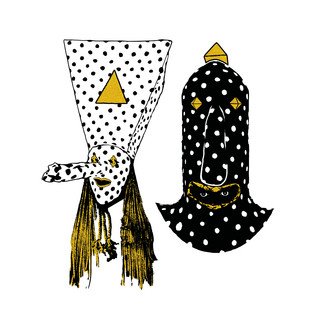
The band is a duo. Khn de Poitrine plays microtonal guitars — instruments built around 24-tone equal temperament, which is the Western chromatic scale split into twice as many notes. That means each note you’re used to has another note halfway between it and the next one, and those new notes are the ones doing most of the work in this band’s writing. Klek de Poitrine plays drums in time signatures that fight you for the first thirty seconds and then settle, on the second listen, into something you can ride. Both of them wear oversized paper-mâché masks during every performance. The masks are big enough that they reportedly limit the players’ visibility of their own instruments. They’ve kept them anyway.
If you have a frame of reference for math rock — Don Caballero, early Battles, Red-era King Crimson, the angular Chicago end of the post-rock canon — that’s roughly the neighborhood. The microtonality is the wrinkle that makes Angine de Poitrine different from the rest of that lineage. Math rock since the late 1990s has mostly worked inside standard tuning, doing its weirdness with rhythm and song-form rather than pitch. Angine de Poitrine moved the weirdness into the pitch domain. Every other note in their songs is a note your ear has been trained to flag as “off.” On a first listen this is uncomfortable. By minute three you’re hearing the cracks-between-the-notes as if they were always there, and going back to a normal twelve-tone guitar feels, for an hour after, slightly impoverished.
That’s the trick. The band is doing twentieth-century academic-composer math — Harry Partch, Easley Blackwood, Wendy Carlos — in a power-trio configuration minus a bass, with the visual aesthetic of a Jim Henson villain. The KEXP session is the proof-of-concept that this combination works in front of a crowd. People watched it. People came back. Art students at the venue drew the band while they were playing, which is a detail KEXP put in the session notes and which is the kind of detail that tells you what kind of room it was.
The set, in order
Four tracks anchor the full performance: “Sarniezz,” “Sherpa,” “Fabienk,” and “Mata Zyklek.” The set runs about thirty-eight minutes. There is no banter. The masks make banter functionally impossible, and the band has decided the masks are non-negotiable, so the structure of the set is: one song, applause, one song, applause, until they’re done. The audience figures out the rules in the first thirty seconds.
“Sarniezz” is the opener and the single. It’s the song that pulled most of the views on the standalone clip. The riff is a four-bar phrase that the band repeats and slowly mutates over the course of two minutes before the first proper section change. The microtones live in the second half of the riff — there’s a descent at the end of bar three that sits a quarter-step lower than your ear is asking for, and the second time around your ear has accepted it and is asking for the second microtone, which arrives. By the time the song hits its third section you’ve forgotten you ever cared.
“Sherpa” is the slow piece, by Angine de Poitrine standards, which means it’s still in 7/8 and still in a tuning your ear is renegotiating with throughout. The drums move from full-kit to something close to a march, the guitar stretches out, and the song earns the title. It’s the track on the set that I’d put on if I were trying to convince someone who liked Tortoise that they could like this band too.
“Fabienk” is the one that has the most fun with the masks. There’s a section in the middle where Klek de Poitrine plays a fill that you can hear arrive about a beat before it should, and Khn responds with a guitar figure that is, in its own way, laughing. You can’t see either of their faces. You don’t need to. The instruments are doing the smiling.
“Mata Zyklek” closes. It’s the heaviest piece in the set — the riff is a galloping figure in 11 that resolves, finally, on a chord that is closer to consonant than anything that’s come before it. The band knew what they were doing. You close on the closest thing to a resolved triad, after thirty-five minutes of intentional dissonance, and the room exhales. That’s the move.
Why two people in masks pulled millions of views
I have a theory and it is not “the masks.” The masks are the bait, but masks alone — there have been a lot of masked acts and most of them are forgotten by the time the second album lands — don’t sustain seven and a half million views. The reason this performance traveled is that the music is legitimately good, and the legibility of “two adults wearing absurd headgear, playing extraordinarily complicated music with total seriousness” is a piece of internet legibility that is rare and contagious. You watch this clip, you send it to one person, the one person sends it to another person, and the loop closes because everyone you send it to has the same reaction: the masks are doing a bit, the band is not.
The band has been very public, in the small amount of press they’ve done, that the masks aren’t ironic. They’re a way of putting the music in front of the personality. In an age where every other band on streaming is trying to develop a “brand” — a face, an Instagram grid, a story — Angine de Poitrine has solved the brand problem by visibly refusing it. The band is a band. The members are interchangeable from your seat in the back. The riffs are not.
The other reason: KEXP’s session videos are the right format for this music. NPR’s Tiny Desk works for songs that benefit from intimacy — voices closer to the camera, acoustic guitars, the texture of a room. KEXP’s sessions, which are typically shot in their Seattle space or on the road at festivals, are different. They give the band a real PA, a real engineer, and a multi-camera rig, and they let the music be as loud and complicated as it needs to be. Angine de Poitrine in NPR’s offices would be a different artifact. Angine de Poitrine on KEXP’s mobile rig at Trans Musicales, with the room’s PA pushing the microtonal harmonics out as if they were normal music, is the actual band.
Why they’re a featured artist, not a playlist track
This is the thing we keep coming back to. The way our curation works at snoopspecial is: most playlists are designed to be shuffled. They’re sequenced if you want to play them in order, but the songs are picked so that any random pull from inside them lands. A great party playlist has 200 tracks of which any 30 will work in any order. A great wind-down playlist has 60 tracks any of which can be the bridge between dinner and the rest of the night.
Angine de Poitrine does not work that way. You can’t shuffle “Sarniezz” into the middle of a playlist between a Foo Fighters song and a Sean Paul song. It would clear a room — not because the song is bad, but because the song needs you to commit. It’s a thirty-eight-minute set, in a tuning your ear has to acclimate to, played by people whose faces you can’t see. That’s a context, not a track. Putting a single Angine de Poitrine song on a mixed playlist is like putting one sentence of a poem in the middle of a magazine article. It doesn’t do the work the rest of the poem is doing.
So we featured the artist instead. The artist page has the full KEXP performance pinned, the Bandcamp link is right there, the bio explains what 24-TET tuning is for, and the visitor can decide for themselves whether they want to take the thirty-eight minutes. Most won’t. The ones who do are who this is for.
What to do after the video ends
A short list of follow-ups, if you want to keep going down this rabbit hole:
- Buy something off their Bandcamp. Bands like this make almost nothing off the streaming numbers. A $10 record is a meal that lasts a week on tour.
- Listen to the studio versions. The KEXP session is the introduction; the records are the case. “Sarniezz” in particular has a studio arrangement that is materially different from the live one, and worth your time.
- Branch out into the lineage. Don Caballero’s American Don. Battles’ Mirrored. King Crimson’s Discipline. Harry Partch’s Delusion of the Fury for the microtonal end. If you liked the way the cracks-between-the-notes felt, that’s where to go next.
The band is on the road. They are pulling rooms an experimental Québécois duo had no business pulling six months ago. The masks are still on. The featured-artist page on this site will stay where it is until the right playlist comes along. Maybe it never does. That’s allowed. Some bands are their own context.
Watch the KEXP. Then watch it again.